

Introduction
Spare parts with regular or moderately variable demand patterns benefit from smoothing models. These models focus on trend detection while filtering out random fluctuations, helping planners make informed inventory decisions.
Understanding Smoothing Models
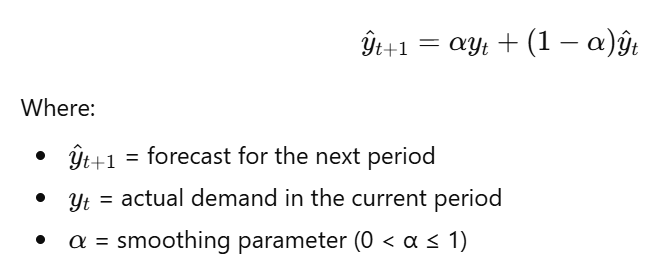
Exponential Smoothing is the most commonly used approach. It calculates forecasts as a weighted average of past observations:
Variants
-
Simple Exponential Smoothing: For stable demand without trends.
-
Holt’s Linear Trend Method: Adds trend component for increasing or decreasing demand.
-
Holt-Winters Seasonal Method: Accounts for seasonality in consumption patterns.
Applications
-
Forecasting regular-use spare parts where demand trends can be identified.
-
Identifying long-term trends and seasonal effects.
-
Improving inventory turnover by reducing overstock.
Advantages
-
Smooths out irregularities to highlight underlying trends.
-
Flexible and easy to implement.
-
Works well for both short-term and medium-term forecasting.
Implementation Tips
-
Select appropriate smoothing parameters based on historical data.
-
Evaluate model accuracy using metrics such as Mean Absolute Error (MAE) or Mean Squared Error (MSE).
-
Regularly review and adjust parameters to adapt to changing demand patterns.


